

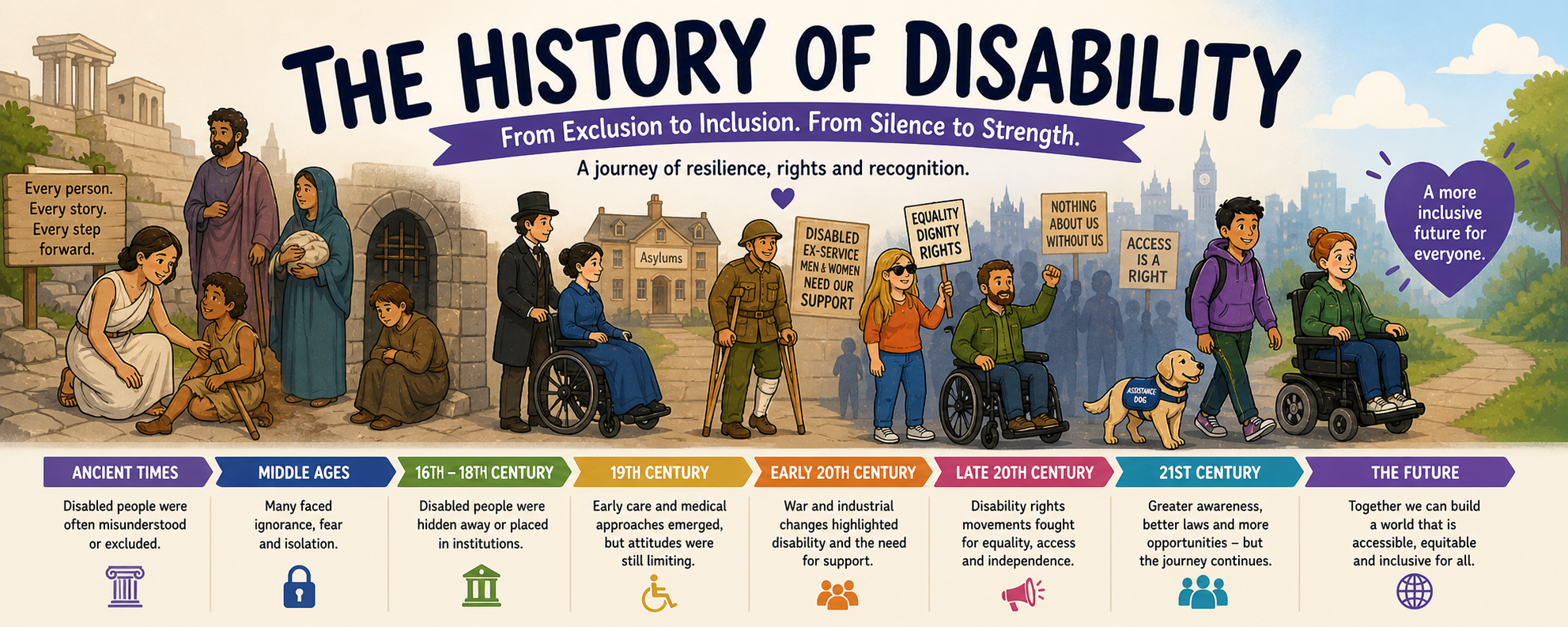
A Brief History of Disability
How Attitudes Towards Disability Have Changed Over Time
The history of disability in the UK reflects a long journey from exclusion and misunderstanding towards greater rights, inclusion, and independence.
Understanding this history helps us recognise how far society has come — and how much progress still needs to be made.
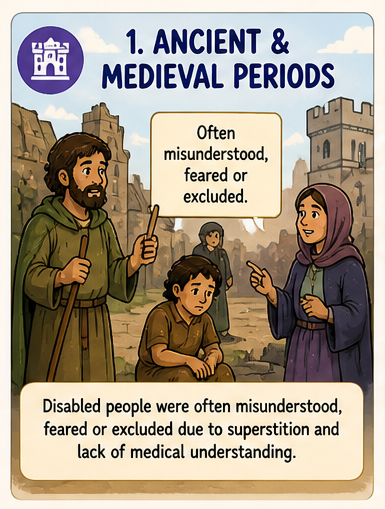
Ancient & Medieval Periods
Historically, disability was often misunderstood and viewed through religious or superstitious beliefs.
Many people believed disability was a punishment, curse, or sign of moral failing.
Support was limited, and disabled people often relied on:
Family care
Religious institutions
Charitable alms-houses
18th–19th Century Institutionalisation
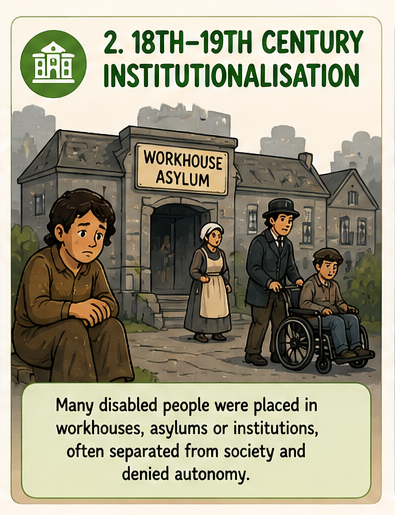
As Britain industrialised, attitudes began to shift:
Disabled people who could not work were often placed in harsh workhouses under the Poor Law system
Medical advances led to disability being seen more as a health condition than a moral issue
Specialist education for disabled children slowly began to emerge
Learn more about the Poor Law and workhouses:
https://www.nationalarchives.gov.uk/education/resources/poor-law/
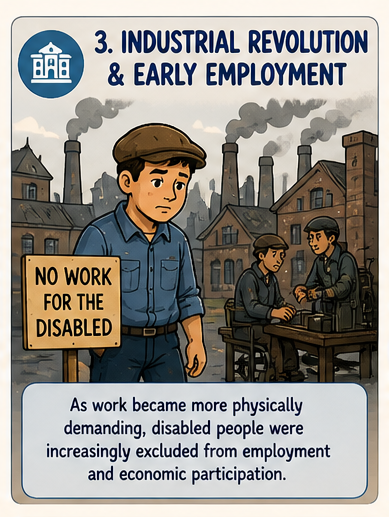
Industrial Revolution
Workhouse System: Under the 1834 Poor Law Amendment Act, disabled people, along with other vulnerable groups, were placed in workhouses. Conditions were harsh, and the system stigmatized those unable to work.
Medical Advances: The 19th century saw significant medical developments, leading to a shift toward understanding disability as a medical condition rather than purely moral or religious.
Education: Institutions for blind, deaf, and other disabled children began to emerge, such as the Royal National Institute for Deaf People (founded in 1924).
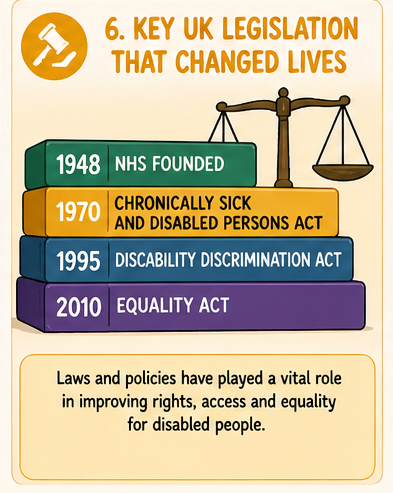
The 20th Century
Major world events dramatically changed perceptions of disability:
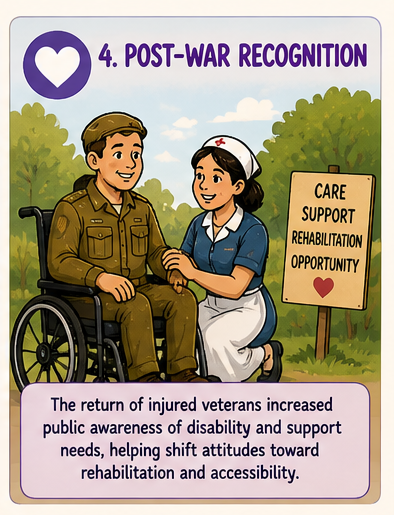
World Wars I and II led to many injured veterans returning home, increasing public awareness of disability
Rehabilitation programmes and war pensions were introduced
The NHS (1948) improved healthcare access for disabled people
The 1944 Education Act increased access to education for disabled children
Learn about the history of the NHS:
https://www.nhs.uk/nhs-services/the-nhs/about-the-nhs/
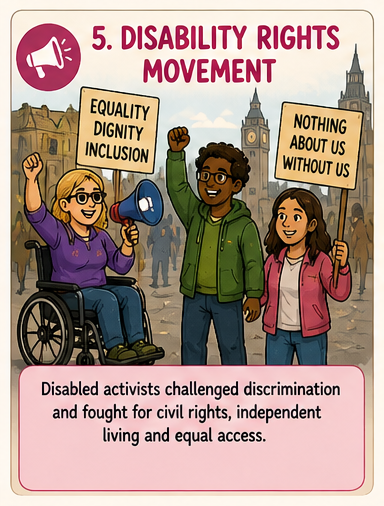
Disability Rights Movement
During the 1960s and 1970s, disabled people began campaigning for equal rights and independence.
This movement challenged outdated attitudes and pushed for:
Better accessibility
Independent living
Equal opportunities
Social inclusion
Key Disability Rights Legislation
Important legal milestones include:
Chronically Sick and Disabled Persons Act 1970
The first law in the world to recognise disabled people’s rights to practical support and servicesDisability Discrimination Act 1995
Made disability discrimination unlawful in many areas of lifeEquality Act 2010
Strengthened protections against disability discrimination and promoted accessibility
Read more about the Equality Act 2010:
https://www.gov.uk/guidance/equality-act-2010-guidance
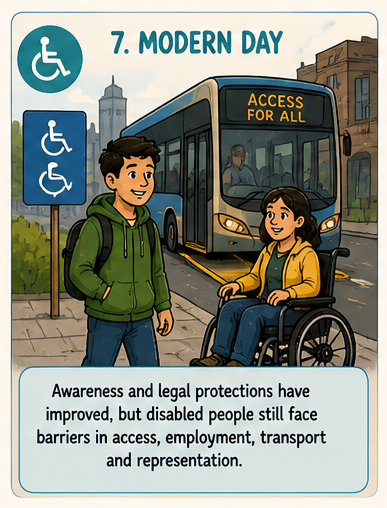
Disability Today
Today, disability is increasingly understood through the Social Model of Disability, which recognises that people are disabled more by barriers in society than by their impairment itself.
While progress has been made, challenges remain around:
Accessibility
Employment
Public transport
Digital inclusion
Representation in society